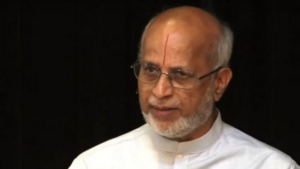
Innerview Kintimadddi Sadananda
October 2024
Innerview
Born in 1944, is a scholar and teacher of Advaita Vedanta in the lineage of Adi Sankaracharya. A materials scientist by profession, he worked at the US Naval Research Laboratory (NRL) as Head of Deformation and Fracture. Since his retirement in 2005, he has been working as a private consultant for six months for the US Navy and spending the rest of his time in Chennai, India, preaching Vedanta. A visiting professor at IIT Madras, in 1978, he became a disciple of Swami Chinmayanandaji, whom he met for the first time in Washington, DC. Soon, Dr Sadananda founded the Washington Regional Centre of the Chinmaya mission and the Sri Siva Vishnu Temple in Lanham, and became the secretary and treasurer of SEVA, Inc., a philanthropic organisation formed in 1980 under the direction of Swami Chinmayananda to fund projects in India and elsewhere. In 1988, at the instance of his guru, he started teaching Vedanta in Virginia. In 1997, Swami Tejomayanandaji gave him the title of ‘Acharya.’
Sada Sir, as he is addressed, is actively engaged in the dissemination of Vedanta through webcasts, talks on YouTube, articles on Advaita websites, and his books, Introduction to Vedanta; Journey Beyond: A Non-Dual Approach (three volumes); and Transcending Science, which are very popular. So far, he has answered more than 700 questions on Vedanta, on the question-and answer platform, Quora.
On the appointed day in September 2023, as soon as my wife and I stepped into the spacious drawing room of his Chennai residence, Sada Sir and his wife, Smt Miralini Sadananda, a well-known Kuchipudi dancer and choreographer, warmly welcomed us. The two hours spent in their presence are still etched in our memory. Sitting on a cosy sofa, wearing a red T-shirt, Sada Sir patiently answered my questions, unravelling different dimensions of Vedanta. His calm demeanour as well as his prompt, logical, and simple way of explaining complex topics were very reminiscent of that of a yesteryear guru.
Excerpts from the exclusive interview with Pradeep Krishnan:
Sir, could you kindly elaborate on your spiritual journey?
My late father, Shree Kuntimaddi Seshacharlu, a staunch Vishishtadvaitin and a Sanskrit and Telugu scholar, when offered to head the Parakala Mutt, a famous Vaishnava ashram, declined it for some reason. He wrote over 100 books in Sanskrit and Telugu. My mother Smt Jayalakshmi, a firm bhakta (devotee), used to teach us slokas while doing her household chores. She formed the Devi Satsang, a ladies’ group that recited the Puranas when their husbands were at work. As a child, I was taken by my grandmother to listen to spiritual discourses. Thus, at home, we were all brought up in a devout Vishishtadvaita atmosphere.
While studying for my 12th grade in Kakinada, I stayed with my uncle, who was a member of the Theosophical Society. There, I started reading the books of J Krishnamurti and was impressed by his logic. I was sure that, to be free, one has to ‘uncondition’ the mind by observing it while in meditation. So I started observing the mind, although in vain. However, pretty soon, I found that it is impossible to observe the mind having countless thoughts, travelling all over the world. I realised that taming the mind by observing the mind is like asking a thief to catch a thief.
Being vexed, I gave up all spiritual pursuits and concentrated on my science studies. I was a gold medallist BSc graduate, did my BE at the Indian Institute of Science and my MTech at IIT Kanpur, and got an assistantship from the University of Pittsburgh. Later, I joined the University of Maryland as a postdoc and then joined NRL as a scientist. Meanwhile, I got married.
In 1978, learning about Swami Chinmayandaji’s talks at the American University, at my wife’s insistence, we went to listen to him. Being a scientist, I was overwhelmed by the logic in Swamiji’s talk on the ‘Logic of Spirituality.’ Impressed by his arguments and analysis, I attended Swamiji’s 10-day-long Kenopanishad class, commencing my Vedantic pursuit.
Subsequently, one day, I wrote a lengthy letter to Swamiji, raising several questions and criticising some aspects of Vedanta. I wanted to know how Vedanta would help the Indian poor, who require more schools and hospitals. Surprisingly, Swamiji wrote back, requesting me to meet him at the University Of Pittsburgh, where he had planned a series of talks. When I met him, he said, “So, you want to help India? We will do it. We will form an organisation to fund those projects you mentioned. But you will be in charge.” He also told me to take the correspondence course on Vedanta to clear my doubts.
During the next year, when Swamiji gave talks in Norfolk VA, an organisation called Seva, Inc. was formed to provide funds for projects in India, with me as the secretary and treasurer. These developments were a result of my letter to Swamiji a year ago. Those days, whenever Swamiji was in the US, I used to attend his discourses and spiritual camps, and being part of the Seva work, I constantly corresponded with him, not only providing him updates on the Seva work but also raising questions about Vedanta.
Meanwhile, I formed study groups and organised several talks for Swamiji as well as camps in different parts of the US. Once the camps were done with and we had surplus funds, as requested by Swamiji, I founded the Chinmaya Mission Centre of Washington DC, and a Brahmachari was sent from India as a Vedanta teacher.
When we needed a teacher of Vedanta in Virginia, Swamiji directed me: “Now you start teaching Vedanta.” Addressing my puzzlement, he told me, “Do not worry; it will come to you easily.” Thus started my Vedanta teaching journey, and it was the best way for me to learn.
How do you view the transformation from a materials scientist to a Vedanta teacher? There is no transformation because Vedanta is also a science. While most of the objective sciences only deal with objectifiable entities using objective tools, Vedanta addresses the subject ‘I,’ the knower, which cannot be analysed using objective tools.
Before exposure to Vedanta, I was interested in peer recognition and was getting the best scientific-paper awards every year. After exposure to Vedanta, as a scientist, my emphasis changed to finding the underlying truth or solving the problem at hand instead of desiring recognition. I opted for retirement in 2005 to devote more time to the study of Vedanta.
Can you please share a memorable instance of your close association with the late Swami Chinmayanandaji?
Once, my wife complained to Swamiji that I was not inclined to send our daughter Keerthana to learn dance at the Kuchipudi Art Academy, Chennai, under Dr Vempati Chinna Satyam. While my wife argued that the girl had to first learn from an authentic teacher before she could learn from her mother, I contended that
Innerview 55
the girl had to be with her mother. Listening to both sides, Swamiji said to my wife, “You are right; she has to learn from a traditional authentic teacher.” Then looking at me he also affirmed that my argument that the girl should stay with her mother at that age was right. After a pause, he declared, “Since she cannot stay with her mother, she will stay with my mother in Chennai and learn dance.” Though puzzled, we left the matter there.
The next day, Swamiji’s secretary informed us that he had sent a cable to one Nambiar Amma in Chennai, stating that Keerthana would be coming to learn dance and music, and would be suitable company for her granddaughter Deepa. We came to know that Swamiji addressed Nambiar Amma, then president of the Madras Chinmaya Mission, as ‘Amma.’ Soon, Keerthana flew to Chennai. Thereafter, every year, she used to visit Chennai till she reached the 11th grade.
I have narrated several other incidents of my long association with Gurudev in the book Self and Supreme.
It is often said that rituals help one purify the mind by getting rid of vasanas, or karmic imprints. What is meant by purification of the mind? Several realised masters, though they themselves do not follow any rituals, advise disciples to practise them.
A mind free from the pressure of vasanas is a pure mind. Purification of the mind means neutralising the vasanas from egocentric actions and desires that involve the ‘I’ and ‘I want,’ or ‘I am the doer,’ claiming the ownership of the action. Thus, projecting egocentricity in actions, with kartrutva bhavam, or the sense of ‘I am the doer’ and bhotrutva bhavam, or the sense of ‘I am the enjoyer,’ causes vasanas.
Vedanta says any action performed with the ego will bind that individual. In the Bhagavad Gita, it is mentioned how Karma Yoga can
Swami Chinmayanandaji
56 LifePositive | OCTOBER 2024
Vedanta says any action performed with the ego will bind that individual. In the Bhagavad Gita, it is mentioned how Karma Yoga can help reduce vasanas. Krishna says, “Do all the actions for the sake of yagna, otherwise they will bind you.”
help reduce vasanas. Krishna says, “Do all the actions for the sake of yagna, otherwise they will bind you.”
Swami Chinmnayanadaji defines ‘yagna,’ as cooperative action performed in a self sacrificing way for the benefit of the totality. Here, since the action is being offered to the Lord, it has to be the best that one can do using their body, mind, and intellect. The spirit of yagna is that everyone should be completely involved in the action, doing their best for the benefit of the totality, which is also called Iswara, or God. Then, the profit from the action should be distributed to all who contributed to its success in proportion to their contribution. In the Bhagavad Gita, Krishna says, “Whatever you do or whatever you eat, offer it to Me with devotion.”
In the process of offering to the Lord, the ego slowly gets dissolved, and the mind becomes purified. Knowing that Arjuna’s mind is not pure enough to meditate, Krishna advises him to fight against injustice although he wants to run away to the Himalayas. At the same time,
in the Bhagavatam, He advises Uddhava, who has been serving Krishna all his life, to go to the Himalayas and meditate.
In essence, purification of the mind means unconditioning the mind. Karma Yoga and Bhakti Yoga are meant to purify the mind and prepare it for Jnana Yoga. In the Bhagavad Gita, it is compared to making all efforts to climb a horse until one can sit on the horse comfortably to ride.
A purified mind that realises what Krishna says—all actions are done by Prakriti only and that one is never the doer—is wise. In essence, rituals undertaken with a proper frame of mind purify it, and that involves recognising one’s role that is being played. Hence, Krishna says, “Skill in action is yoga.” Whatever one is doing, in the house, office, or anywhere else, doing one’s best is yoga, and one must consider it as a ritual to sanctify the action. Therefore, a ritual is not merely doing something in the puja room. Considering the whole universe as a temple, every rightful, or dharmic, action becomes a ritual, helping to purify the mind. If already purified, these actions become loka
Innerview 57
kalyanam; they benefit the whole of Creation, as was done by Avataras in the Puranas.
As long as one is wearing the costume of body, mind, and intellect, and is on the stage of Life, one cannot but play the roles that destiny has assigned. I am playing the role of my life and have nothing to do with others playing their roles properly or not.
One cannot realise the Self by reading books or by listening to talks. Then what are the benefits of doing so? How can one make intellectual understanding experiential? How can one put into practice what is heard and read?
To make the intellect understand the Truth by clearing the wrong notions, the scriptures advise the seeker to learn from a teacher. Learning, being an intellectual process, eliminates all misconceptions as well as makes the mind free from all wrong notions, which indeed is the purification of the mind. As the mind gets cleansed, the intellectual understanding will sink in as aparoksha jnanam, or jnana gained by transcending the senses, thereby revealing the Truth: You are That, or Tat tvam asi.
The critics of Vedanta, like the Neoadvaitins, considering it an intellectual exercise, are of the view that one has to only meditate to realise the truth. However, Vedanta instructions are clear. In his Karika on the Mandukya Upanishad, Goudapaada exhaustively discusses the obstacles to realisation, saying, “shrotavyaH, mantavyaH, nididhyasitavyah [‘tavyaH’ means ‘one should do it’]. It means that first one should undertake shravana, or listening to the teaching for a prolonged length of time under a competent teacher [a competent teacher is one who has studied under another competent teacher]. Then one should proceed to manana, discussing with peers or reflecting on the
58 LifePositive | OCTOBER 2024
teaching until no doubts are left. And if one has not yet realised it, then the final step is nididhyasana, or meditation on the teaching received till the mind abides in that Knowledge. The truth is defined in mantra seven of the Mandukya Upanishad, and, in the end, it says, “Tat vijnasasva, tat braheti.” That has to be enquired using the intellect only, to discover Brahman. Thus, reading books and listening to talks are helpful tools.
Do I really have free will?
The Bhagavad Gita says that you have a choice of action. You always have three choices: to do it, not to do it, or do it another way. Not to do when doing is needed is also a choice of action, and you are accountable for such actions. Krishna further says that you do not have a choice in the results. You act hoping that the results will be what you want. Here is a simple example: I have a stone in my hand, and I can throw it to the left side, right side, front, back, or up in the sky. These are my choices. However, I cannot control its trajectory once I throw the stone. It is determined by the laws of Nature: gravitational force, frictional forces, or some obstacles that suddenly come in its path. I must accept the results and act better next time so that the stone goes where I want.
In essence, one can act only in the present or the Now. The results come after the action is performed. Acting is my free will, and the results are my destiny. Swami Chinmayananda states, “What I have is prarabdha, or destiny, and what I do with what I have is purushartha,
or free will.” The future destiny or prarabdha is past prarabdha modified by my present action. Thus, I am a prisoner of my past but a master of my future. That is the interplay of free will and destiny.
What to think is a choice of action. I am
responding to your questions only after thinking; they are not random thoughts. A wise man also thinks but attributes that thinking to the Lord. But for transactional purposes, he will say “I thought and wrote.” He does not have to use some strange language to communicate. He also says, “I am hungry; I am sleepy; I do not want that; I like this; etc., for worldly communication.
Acharyaji, what is your understanding of God?
A million-dollar question. All religions say that God is omnipresent; He is present everywhere. As per Vedanta, Creation involves two causes: an intelligent cause and a material cause. Many religions talk about God only as an intelligent cause. Vedanta says He is not only the intelligent cause but also the material cause of the Creation.
I want to create a pot. I may know how to make
a pot (intelligent cause), but to make it I need materials, tools, and skills. If God is going to create the whole universe, he should not only have the Knowledge of how to create but also the material to create and the skills and tools needed to create. He cannot go and get the material from somewhere else; the material for Creation also should come from Him. He is all the causes required for Creation. Hence, Vedanta says that He, Himself, became many. Thus, the whole Creation is nothing but Him only.
Hence, where and how do I see him? I must see Him through every created entity, since everything I see or transact with is only His expressions, starting from my body. I see His presence in me; I see Him when I look at my wife sleeping next to me. I see Him in the birds that are flying around. I see Him in the plants and flowers. Everywhere I look, I cannot but see Him. There is no way I can avoid seeing
Dr Kuntimaddi Sadanada
Innerview 59
him. All I must do is remember all the time that everything is nothing but His expressions. That is how I see Him. Yet, while transacting, I must differentiate between individuals, animals, and plants.
Krishna says that a wise man sees oneness that pervades a scholar, a cow, an elephant, a dog, and even a dog-eater. That vision is called samatvam, or equanimity, in Sanskrit. Yet differentiation is made at the transactional level. It is like a scientist who knows everything is made up of electrons, protons, and neutrons, but he differentiates at the transactional level: garbage vs delicious food.
What are your prescriptions for one to lead a happy, peaceful, and contented life? The Vedas provide that prescription: Earn as much as you can in a dharmic way. First, fulfil your obligations such as taking care of your family, including your bodily needs. However, what a family wants could be different from what it needs. Try to fulfil their desires in a dharmic way and if you can afford them. Fulfil your obligation to society by paying taxes, etc. Save some money for your future to ensure that your dependence on others and society is minimal. Donate as much as you can to the right causes. Spend some time in the study of Vedanta under the guidance of a teacher. Until you find the right teacher, allot some time for satsang. Perform all actions as Karma Yoga. Pray first
thing in the morning and last thing before you go to sleep. These help the mind to be peaceful.
How are you able to reconcile your life as a scientist and as an Acharya of Advaita Vedanta? Vedanta is science, and science means Knowledge. Science is derived from the Latin root ‘Scire,’ meaning ‘to know.’ In Sanskrit, ‘vid’ means to know, and ‘veda’ means ‘Knowledge,’ i.e., science. The objective sciences rely on objective tools for analysis and, therefore, cannot analyse the subject ‘I,’ a conscious entity. On the other hand, Vedanta discusses the subject ‘I,’ its experience as a waker, dreamer, and deep sleeper, and the absolute Truth beyond the three states of consciousness.
The more I studied Vedanta, the more I could appreciate the depth of Knowledge concerning the objective sciences, which Vedanta considers as mithya, neither real nor unreal but needed for transactional purposes.
For me, working on the objective sciences is fun, and I still write scientific papers and also help young scientists who want some guidance. Since retirement, I have devoted my time to both Vedanta and science, switching back and forth on a need basis, without any conflict.
Sir, your message to the readers?
Study Vedanta under a competent teacher and follow them until you discover the Truth. That is the very purpose of Life itself.
Pradeep Krishnan is a student of consciousness, based in Kerala. A seeker by nature, he is deeply attracted to the teachings of Sri Ramana Maharshi and Sri Nisargadatta Maharaj.

Discussion (0)
No comments yet. Be the first to comment!
Leave a Comment
You need to login to post a comment.