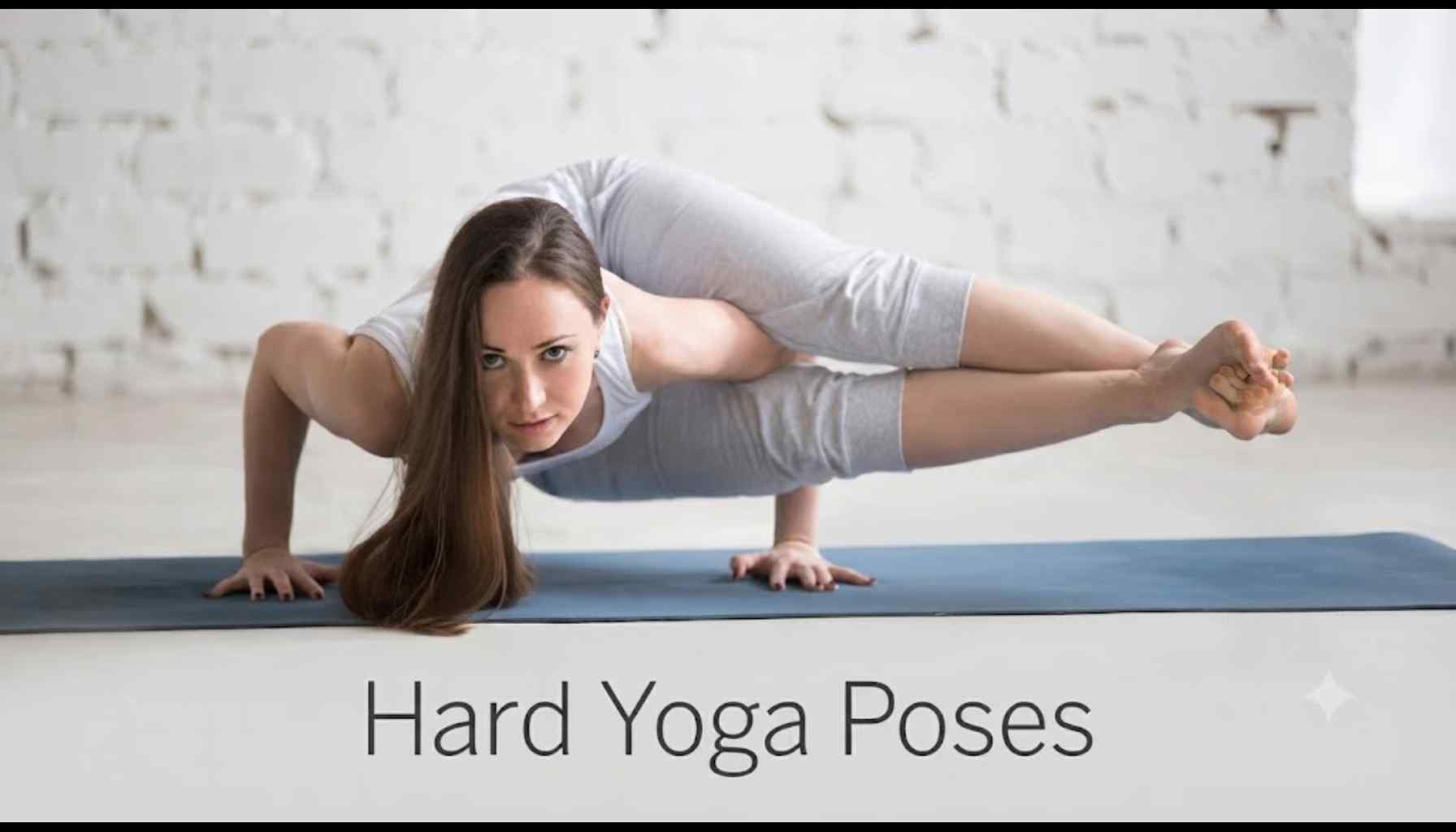
Hard Yoga Poses: What Makes Them Challenging?
Hard yoga poses transform practice into a test of strength, flexibility, balance, coordination, and focus. Advanced postures combine physical demands at once. The goal is not to force impressive shapes, but to develop control and awareness gradually.
Key Takeaways
- Build strength and flexibility before advanced poses.
- Practise difficult asanas gradually with proper alignment.
- Use props and guidance to reduce injury risk.
Understanding Hard Yoga Poses
Hard yoga postures refer to difficult asanas that demand that the body go beyond its natural limits. It can be caused by strength in the wrists and shoulders, hip flexibility, spine flexibility, balance, and breath control.
Everyone’s difficulty is subjective. Having flexible hips may make Hanumanasana easy, and having strong shoulders may make inversion easier. Hard yoga poses can be practised to challenge your limits.
10 Hard Yoga Poses to Challenge Your Practice
1. Adho Mukha Vrksasana (Handstand)
The handstand will test shoulder stability, wrist strength, core stabilization, balance, and focus. You should start your practice with wall supports, forearm planks, and Dolphin pose.
2. Bakasana (Crow or Crane Pose)
In bakasana, you need to support your body on the arms and wrists, while at the same time using your core to control the center of gravity. Before this pose, you should do malasana, chaturanga, and boat pose.
3. Vrschikasana (Scorpion Pose)
Scorpion pose involves both an inversion and an extreme backbend. This requires strong shoulders, forearms, spine, and hip flexibility. You should work towards scorpion pose from Forearm Stand, camel, and wheel poses.
4. Astavakrasana (Eight-Angle Pose)
This arm balancing pose includes twisting, hip flexibility, hamstring flexibility, and core strength. Prepare for this pose by doing boat pose, firefly, and lizard pose.
5. Eka Pada Rajakapotasana (One-Legged King Pigeon)
This advanced pose requires hip openers, backbends, and shoulder stretches. Practice pigeon pose, low lunge, and easy quad stretches.
6. Kapotasana (King Pigeon Pose)
Kapotasana takes backbending deeper and requires mobility through the spine, shoulders, hips, and quadriceps. Practise progressively with Camel, Bridge, and Wheel variations.
7. Hanumanasana (Monkey Pose)
Hanumanasana resembles a full split and demands considerable hamstring and hip-flexor flexibility. Use blocks for support and work through Low Lunge and Half Split.
8. Mayurasana (Peacock Pose)
Mayurasana balances the body horizontally on the hands while the elbows press into the abdomen. It requires strong wrists, forearms, shoulders, core, and precise weight distribution.
9. Pincha Mayurasana (Forearm Stand)
Forearm Stand requires stable shoulders, active forearms, core engagement, and balance while inverted. Dolphin Pose and wall-assisted holds can build the foundation.
10. Ganda Bherundasana (Chin Stand)
Chin Stand combines an advanced arm balance with a deep backbend. Attempt it only after developing substantial shoulder strength, spinal mobility, balance, and guidance.
Duration and Frequency: Advanced poses do not need daily repetition. Practising focused progressions around three to four times weekly allows strength and mobility to develop while giving the body time to recover. Recovery sessions can fill remaining days.
Benefits of Practising Advanced Yoga Poses
Advanced yoga poses can help strengthen the whole body together since multiple muscles work at once.
- Arm balances and inverted postures can increase body awareness.
- Deep stretches in hip openers and backbends can slowly enhance flexibility when done properly.
- Hard practice improves concentration.
- A challenging pose demands one's attention, thus it helps concentrate and breathe properly.
- Patiently working towards a hard pose can increase self-confidence.
How to Prepare for Hard Yoga Poses
Preparation should reflect the physical requirements of your pose. Warm up the wrists and shoulders prior to any arm balances, the hips and hamstrings for splits, and the spine for backbends.
Cat-Cow, Downward-Facing Dog, Low Lunge, Malasana, Chaturanga, Boat Pose, Bridge Pose, and Dolphin Pose are all beneficial for preparing for certain poses. Props may be helpful to decrease strain and to comprehend the correct form.
Do not rely on momentum to gain range. Always move with control, breath steadily, and cease when feeling sharp pain, numbness, or excessive pressure.
Common Mistakes to Avoid
- Failing to warm up before doing advanced yoga poses.
- Forcing flexibility before gaining strength in the pose.
- Breathing retention when assuming a difficult posture.
- Ignoring alignment in favor of going deeper.
- Practicing inversions without proper guidance.
- Comparing your pose with that of another practitioner.
Properly exiting the pose is critical in inversions and deep backbends as the loss of balance may subject the wrists, shoulders, neck, and spine to unexpected strain.
Final Thoughts
Hard yoga poses are advanced skills built through patience, preparation, strength, mobility, balance, and breath awareness. Choose one realistic goal, strengthen its foundations, use appropriate modifications, and progress gradually. The real achievement is learning to move with control, confidence, and respect for your limits.
FAQs
1. What is the hardest yoga pose?
There is no universally hardest yoga pose because difficulty depends on individual strength, flexibility, balance, anatomy, and experience.
2. Can beginners do hard yoga poses?
Beginners should avoid jumping directly into advanced poses but can work toward them through suitable progressions and professional guidance.
3. Which yoga pose requires the most flexibility?
Deep backbends, full splits, and advanced hip-opening poses such as Kapotasana and Hanumanasana generally demand exceptional flexibility.
4. How long does it take to master hard yoga poses?
The timeline varies widely, with some postures taking months or years depending on your starting ability and the pose.
Also Read: Difficult Yoga Pose
By Umesh Kumar Khiri

Discussion (0)
No comments yet. Be the first to comment!
Leave a Comment
You need to login to post a comment.