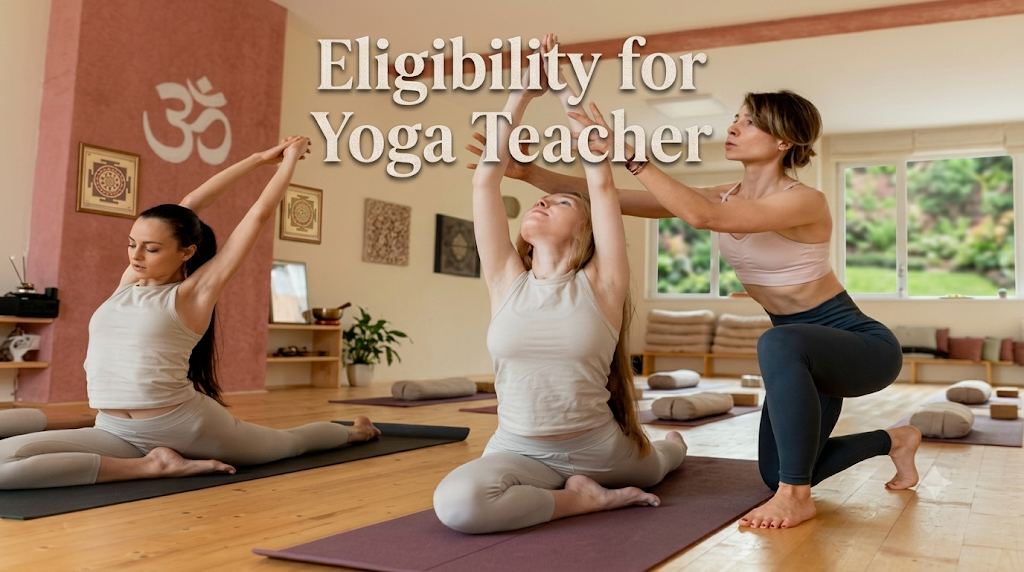
Eligibility for Yoga Teacher: Qualifications You Need
Understanding the eligibility for yoga teacher roles is the first step toward a teaching career. Unlike many professions, yoga has no single national rule that says who may teach, so requirements depend on the route you choose: a government-backed certification, an international teacher training course or a university degree. This guide explains each pathway, the usual entry requirements and how to check whether you're ready.
Key Takeaways
- No single rulebook: Eligibility depends on whether you follow an Indian government, international or academic route.
- Entry bars are modest: Many courses ask for a minimum age, basic education and some personal practice, not a yoga degree.
- Certification builds trust: A recognised certificate helps with jobs, insurance and student confidence.
What Is the Eligibility for Yoga Teacher Programmes?
The eligibility for yoga teacher programmes covers the age, education, experience and health conditions that a school or certifying body expects before you can enrol or qualify. In practice, there is no law in India requiring every yoga teacher to hold a certificate. However, serious employers, gyms, schools and wellness centres generally expect one, because incorrect teaching can strain students' bodies. That is why most aspiring teachers follow one of the structured pathways below.
Three Main Pathways at a Glance
|
|
|
|
|
|
|
|
|
|
|
|
|
|
|
|
|
|
|
|
Yoga Certification Board Levels and Entry Requirements
India's Yoga Certification Board (YCB), set up under the Ministry of AYUSH, certifies yoga professionals at several levels. The details below reflect commonly published guidance, and individual institutes may be flexible, so always check with the centre.
- Yoga Volunteer: The entry level, with around 36 hours of training. It is open to people below 75 years of age and suits those who want to assist in group classes.
- Yoga Protocol Instructor: Usually expects completion of Class 10, with about 200 hours of training.
- Yoga Wellness Instructor: Usually expects Class 12 and around 400 hours of training, with a focus on health and disease prevention.
- Yoga Teacher and Evaluator: Generally prefers a bachelor's degree in any stream and about 800 hours of training.
- Yoga Master: The highest level, usually preferring graduates and requiring at least 1,600 hours of training.
Each level involves an exam. The lowest level is theory-based, while the others combine theory with a practical test. Certificates are typically valid for five years and are renewed through a short continuing education programme.
Eligibility for International 200-Hour Courses
Many yoga schools in India and abroad follow standards set by Yoga Alliance, an international registry. Their 200-hour courses are among the most popular starting points. Typical requirements include:
- Age: Usually 18 or above.
- Practice: Regular experience with yoga, though advanced poses are not required.
- Health: Good enough physical and mental health to take part in daily practice.
- Conduct: Some residential schools have lifestyle rules, such as avoiding alcohol and drugs during the course.
- Education: Often no formal degree is needed.
A 200-hour certificate is generally seen as the baseline for teaching in studios and wellness settings. Further levels, such as 300 and 500 hours, add depth if you want to advance.
Do You Need a Yoga Degree?
No. A diploma, bachelors or masters in yoga is important if you want to pursue a career in academic or research field or as a therapist or want to teach at a place where formal qualifications are necessary. However, for all other community and studio based teaching a recognized certificate in teacher training will do just fine. There are many who believe that even if one has a degree they should go for a teacher training course as teaching techniques such as sequence and cue are an entirely different craft.
Step-by-Step Plan to Become Eligible
- Set your goals: Decide if you want to be a yoga teacher in India, foreign countries, a therapist or academic professional.
- Develop your personal practice: Join yoga classes and get acquainted with basics of yoga.
- Select the pathway: Compare YCB, foreign and academic pathways.
- Confirm the school: Ensure that it offers a recognized course.
- Gather documents: Keep identification, education certificates and a passport-sized photo ready, as many institutes ask for them.
- Complete the training: Attend sessions, practise teaching and prepare for exams.
- Get certified and renew: Keep track of validity periods and renewal requirements.
Common Mistakes to Avoid
- Choosing a course based only on price or a short duration.
- Assuming every certificate is equally recognised.
- Skipping the practice teaching component.
- Ignoring health conditions that affect your participation.
- Believing that training ends when the certificate arrives.
Final Thoughts
The eligibility for yoga teacher training is more flexible than many people expect, but the right pathway still matters. Choose a route that fits your goals, prepare through steady practice and select a school with transparent standards. With the right foundation, you can teach safely, confidently and with lasting benefit to your students.
FAQs
1. What is the minimum qualification to become a yoga teacher?
There is no single minimum. Some Indian certification levels ask for Class 10 or 12, while many international courses require only that you are 18 and have some regular practice.
2. Can I become a yoga teacher without a degree?
Yes. A recognised teacher training certificate is usually enough for studio and community teaching, though degrees help in academic and therapeutic roles.
3. What is the age limit for yoga teacher training?
Most courses set a minimum age of 18. Some entry-level certifications have an upper limit, so check the rules for the specific programme.
4. Is certification compulsory to teach yoga in India?
There is no general legal requirement, but employers and institutions often prefer certified teachers. For information on the government's voluntary certification system, visit the Yoga Certification Board.
Also Read: Yoga Wheel
By Umesh Kumar Khiri


Discussion (0)
No comments yet. Be the first to comment!
Leave a Comment
You need to login to post a comment.