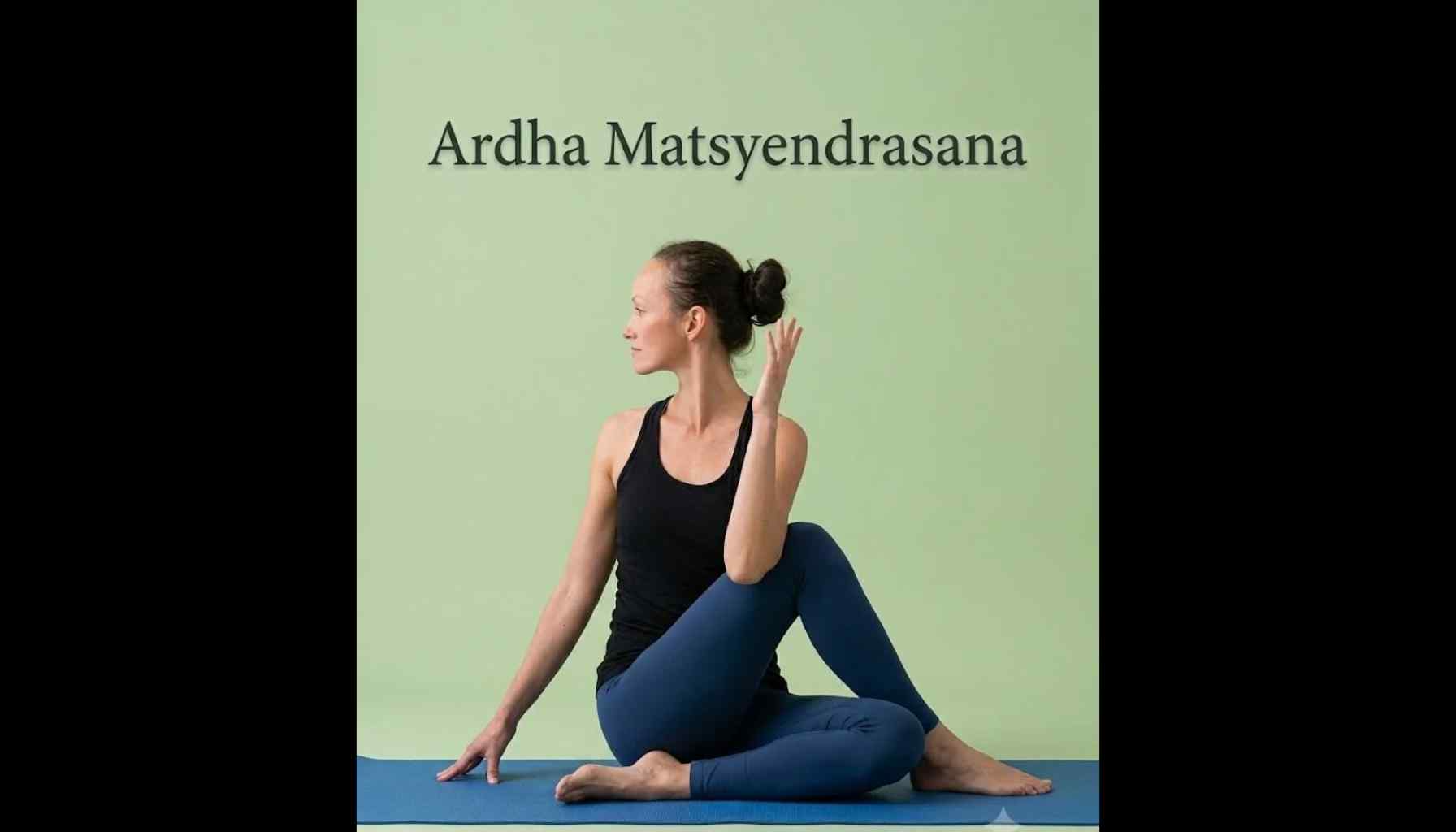
Ardha Matsyendrasana: Powerful Benefits and Safe Steps
Ardha Matsyendrasana is the seated twist many of us meet in an early yoga class and then quietly avoid, because it feels awkward at first. That is a shame. Practised with care, it is among the simplest ways to wake up a back that has spent the day folded over a desk, a steering wheel, or a phone.
This guide walks through what the pose really does, what research can and cannot support, how to practise it without strain, and who should sit it out. You will find no miracle claims here, only what holds up.
Key Takeaways
- Ardha Matsyendrasana mainly rotates the mid-back, stretches the outer hips, and asks your core to keep you tall.
- The evidence is modest. Yoga as a whole can ease stiffness, stress, and mild back pain a little, but detox and disease-cure claims are not proven.
- Lengthen your spine first, then twist from the ribs, never from the neck.
- Hold each side for about half a minute at first and keep breathing the whole time.
- Skip or modify the pose after spinal or abdominal surgery, with disc trouble, with a hernia, or during pregnancy, and speak to a doctor first.
At a Glance
- Level: beginner to intermediate, with modifications
- Hold: about half a minute per side to start
- Focus: mid-back, outer hips, and deep core
- Best placed: after a warm-up, in the middle or near the end of a session
- Props: a folded blanket or block, if needed
What Is Ardha Matsyendrasana?
The name comes from Sanskrit. Ardha means half, matsya means fish, indra means lord, and asana means pose. That is why many teachers call it the half lord of the fishes pose, and why you will also hear it called the half spinal twist.
Say it as ar-dha mat-syen-DRAH-sa-na. Traditional texts describe the full Matsyendrasana, and the half version is a more accessible adaptation that modern classes favour.
Tellings of the legend differ. In some, the sage Matsyendranath overheard Shiva’s teaching of yoga from inside a fish. In others, a fish listening from the shore is transformed into the sage. Either way, he is remembered as an important teacher in the Hatha yoga tradition, and the story hints at the spirit of the pose: turning inward and listening.
The full pose, Matsyendrasana, asks for much deeper hip rotation. The half version is the one most people practise because it adapts to nearly any body. It is a seated spinal twist, usually done after a warm-up, in the middle or near the end of a class.
What Happens in Your Body During a Seated Spinal Twist
Your spine does not rotate evenly. The mid-back, known as the thoracic spine, is built for rotation. The lower back, in contrast, has very little twisting range and does not like being cranked. A good twist therefore starts at the ribs and travels upward, while the pelvis stays heavy and grounded.
As you turn, the crossed leg pulls the outer hip and glute into a stretch. The obliques, the deeper abdominal muscles, and the small erector spinae muscles beside your spine work gently to keep you tall. The chest and the front of the shoulders open, which often makes the next breath feel roomier.
Benefits of Ardha Matsyendrasana: What the Evidence Supports
Very little research studies Ardha Matsyendrasana on its own. Most evidence looks at yoga programmes as a whole, so the honest approach is to separate reasonable benefits from bold promises.
Easier mid-back movement and better posture awareness
Long hours of sitting stiffen the thoracic spine. Regular gentle twisting restores some of that movement, and the pose teaches you to notice when you are slumping. Better awareness often matters more for posture than any single stretch.
Looser hips and glutes
The crossed-leg position stretches the outer hip, an area that tightens in people who sit, walk, or run a lot. Looser hips can reduce the pull on your lower back.
Core and spinal support
Lifting tall before you rotate asks the deep trunk muscles to work in a controlled way. It is mild strengthening rather than a workout, but it is useful practice for steady, supported movement.
Calmer breathing and stress relief
Slow breathing is built into the pose. Yoga programmes are linked with modest improvements in stress and mood, and a twist that opens the chest gives you a good reason to breathe slowly and fully. This is where many people feel the difference first.
Relief for stiff, achy backs
A Cochrane review of yoga for long-lasting low back pain found small improvements in pain and function compared with no exercise. The gains were modest, and back pain itself was the most common side effect. The trials also used routines designed for back pain and taught by experienced instructors.
So yes, yoga can help some people. No, a single twist is not a treatment. If your back already hurts, start gently and get advice before deepening the pose.
Digestion: a traditional claim with thin evidence
Yoga texts describe twists as a massage for the abdominal organs, and some people feel less bloated afterwards. Solid modern evidence is thin. Treat any digestive comfort as a pleasant bonus, not a promise.
Claims That Go Too Far
Online articles often say Ardha Matsyendrasana detoxifies the body or cures kidney disease, asthma, or diabetes. These claims are not supported by strong evidence. Detoxification is already the job of your liver and kidneys, with help from your lungs and skin.
Some small studies suggest yoga programmes may help blood sugar control, but those results do not prove this pose treats diabetes. Never stop or change medication because of yoga. Think of the pose as a mobility and relaxation tool, not a medical therapy.
How to Do Ardha Matsyendrasana Step by Step
Warm up first. A few minutes of cat-cow, shoulder rolls, and a gentle reclined twist prepare the spine. Rotating a stiff, cold spine is a common route to next-day soreness. Think of the half spinal twist as lift first, rotate second.
The steps below describe the right-sided version. Repeat on the other side afterwards.
- Sit tall. Begin in staff pose with your legs straight. If your back rounds or your knees rise above your hips, sit on a folded blanket.
- Set the bottom leg. Bend your left knee and bring the left foot beside your right hip. If that bothers your knee or hip, keep the left leg straight.
- Cross over. Bend your right knee and place the right foot on the floor outside your left thigh, with the knee pointing up.
- Lengthen. Rest your right fingertips on the floor behind you, then inhale and grow taller from the top of your head.
- Twist. Exhale and rotate the belly, then the ribs, then the chest, and finally the shoulders. Let your gaze follow last, over the right shoulder.
- Choose your arm. Hug the right knee with your left arm for a gentle version, or hook your left elbow outside the knee for a deeper one. Let the elbow steady you, and never push your body around with it.
- Breathe. Grow taller on every inhale and deepen the twist slightly on every exhale. Hold for about half a minute, building toward a full minute over time.
- Release and switch. Unwind slowly, pause in the centre, and repeat on the left.
A quick alignment check
Check that your weight stays even across your seat, your chin sits level, and your breath stays smooth. If you cannot breathe easily, you have twisted too far.
Modifications and Variations for Every Body
- Tight hips or hamstrings: sit on a block or folded blanket.
- Sensitive knees: keep the bottom leg straight and hug the top knee.
- Limited mobility or office breaks: sit sideways on a sturdy chair, hold the backrest, and turn gently.
- Lower back comfort: rest the back hand on a block so you are lifting rather than leaning.
- More challenge: once the basic shape feels easy, explore Marichyasana C or Vakrasana. Leave full Matsyendrasana for when a qualified teacher is guiding you.
- Bound and half-lotus versions: experienced students may meet a bound version, where the hands clasp behind the back, or versions that fold one leg into half lotus. Learn these with a teacher.
Whichever version of Ardha Matsyendrasana you choose, the half lord of the fishes pose should feel like a comfortable stretch, with no sharp or pinching sensation.
Common Ardha Matsyendrasana Mistakes and Easy Fixes
- Twisting from the neck. Start the turn in the mid-back, and let your head follow at the end.
- Rounding the lower back. Sit higher and lift before every twist.
- Using the elbow like a crowbar. Hug the knee instead.
- Leaning back on the supporting hand. Bring it closer to your hips or place it on a block.
- Lifting one sitting bone. Shift slightly until both feel the floor.
- Holding the breath. If you cannot speak in a calm voice, ease off.
Who Should Avoid or Modify This Pose
The half lord of the fishes pose is gentle for many people, but not for everyone. Check with a doctor or physiotherapist before practising if any of these apply:
- Recent spinal or abdominal surgery
- A herniated or bulging disc, or sciatica that flares with twisting
- Osteoporosis or low bone density
- An abdominal hernia or a painful stomach ulcer
- A knee or hip injury
- Uncontrolled high blood pressure or heart problems, where straining and breath-holding are risky
- Pregnancy, especially the later months, when deep twists that squeeze the belly are best avoided. A prenatal teacher can offer gentler open twists.
Some traditional teachers also advise skipping deep twists during heavy menstruation, so let comfort guide you. Stop at once if you feel sharp pain, tingling, numbness, or dizziness, and treat any of them as your cue to ease out.
How Often to Practise and Where It Fits
Most days is fine if the pose feels comfortable. A few rounds on each side after a warm-up, or near the end of a session, is plenty. Practise on a fairly empty stomach, a couple of hours after eating.
Desk workers can slip in a short round between meetings. Pair the twist with hip openers, and straight afterwards choose a gentle forward fold or a reclined rest so the spine can settle. This seated spinal twist also complements walking and strength training rather than replacing them.
Frequently Asked Questions
Is Ardha Matsyendrasana good for back pain?
It can ease general stiffness for some people, mainly by improving mid-back movement. If you have active or severe pain, a disc problem, or sciatica, get medical advice first and begin with a very small range, or skip twists for now.
How long should you hold Ardha Matsyendrasana?
Begin with about half a minute on each side and build toward a minute if it feels good. Smooth breathing matters more than a longer hold. Some sources suggest staying for a few minutes, but that suits experienced practitioners better than beginners.
Is the pose good for diabetes?
Small studies suggest yoga programmes may support blood sugar control, but there is no proof that this pose treats diabetes. Use it alongside, never instead of, your medication and your doctor’s advice.
Does it reduce belly fat?
Not by itself. Twisting does not burn fat from the waist, and the half spinal twist is no exception. Lasting fat loss comes from overall activity, food choices, and sleep. The pose can help you feel more comfortable moving, which supports those habits.
Is Ardha Matsyendrasana safe during pregnancy?
In later pregnancy, deep twists that squeeze the belly are best avoided. A prenatal yoga teacher can show gentler open twists, and your doctor or midwife should approve any practice.
Is Ardha Matsyendrasana good for kidneys?
There is no good evidence that it improves kidney function or treats kidney disease. Some sources say twisting stimulates the kidneys, but that is a traditional idea rather than a proven effect. Kidney health depends on blood pressure, blood sugar, hydration, and medical care. If you have kidney disease, check with your doctor before starting any new routine, and never use yoga in place of treatment.
Is Ardha Matsyendrasana good for asthma?
It may help you breathe more comfortably, because the pose opens the chest and encourages slow breathing, and gentle exercise can support people with asthma. There is no proof, however, that it treats or cures asthma. Keep using your prescribed inhaler and action plan, stay within a comfortable range, and ease out if you feel tight or wheezy. Ask your doctor first, especially if your asthma is not well controlled.
Is Ardha Matsyendrasana good for weight loss?
Not on its own. The pose is gentle, burns few calories, and cannot target fat in any one area. Weight loss comes mainly from regular activity, food choices, sleep, and time. It can still earn a place in your routine by keeping your back and hips mobile, which makes it easier to stay active.
Bottom Line
Ardha Matsyendrasana will not detox your organs or cure disease, and it does not need to. What it can do is give a stiff, sedentary back a little more movement, open the hips and chest, and slow down your breathing. Approach it with a long spine, a patient pace, and honest limits, and it becomes a reliable habit worth keeping.
Discussion (0)
No comments yet. Be the first to comment!
Leave a Comment
You need to login to post a comment.